

Backyard Transformation Video AI. An overgrown yard to a finished garden, from one camera.
Describe the yard as it is and how it should end up, and Treza draws the finished garden, works back to the overgrown yard in five edits, and animates the work in between. You get a vertical transformation timelapse from one fixed camera.
Everything on this page was made on Treza.
Describe the before and the after
Say what the yard is, how overgrown or worn it is, and what it should become: a lawn, a patio, beds, a path. The planner writes the stages in between.
The finished garden is drawn first
Nano Banana Pro draws the finished yard, and each earlier stage is an edit of that still. The fence, the house wall, and the camera stay where they are while the yard changes.
Days pass in seconds
Each clip is shot from a locked-off camera while the light shifts between morning and evening and the shadows sweep across the yard.
Clearing, digging, and laying
From the second stage on, the yard is a working site with tools and materials where the work is happening, and all of it is gone for the finished stage.
Nothing from the after leaks into the before
Each stage edit lists what has not been done yet and keeps it out: new planting, fresh lawn, paving, lights.
A stills version at a lower price
The budget version shows the same six stages as stills with a slow camera push instead of five animated clips, for a first look before the full render.
Made on this platform
Real output, credited under every frame.

Architectural
A dolly through a sunlit room.
Seedance 2.5

Product
A macro turn under a sweeping light.
Kling 3.0 Pro

A channel cut
Written, voiced, captioned, and published on a schedule.
Seedance 2.5
From idea to finished video
- Step 01
Describe the yard
Open the Restoration Timelapse template and say what the yard is like now: its size, the fence or the house behind it, and what is overgrown, broken, or bare.
- Step 02
Describe the finish
Name what you want at the end: the lawn, the patio or deck, the beds, the path, the trees, the season.
- Step 03
Run it
Check the version and its price, then run. The finished garden, the five earlier stages, the clips, and the cut come back as one timelapse.
- Step 04
Adjust a stage
If one stage jumps too far, rerun that stage node on the canvas and the clips either side of it. Add a music node for sound.
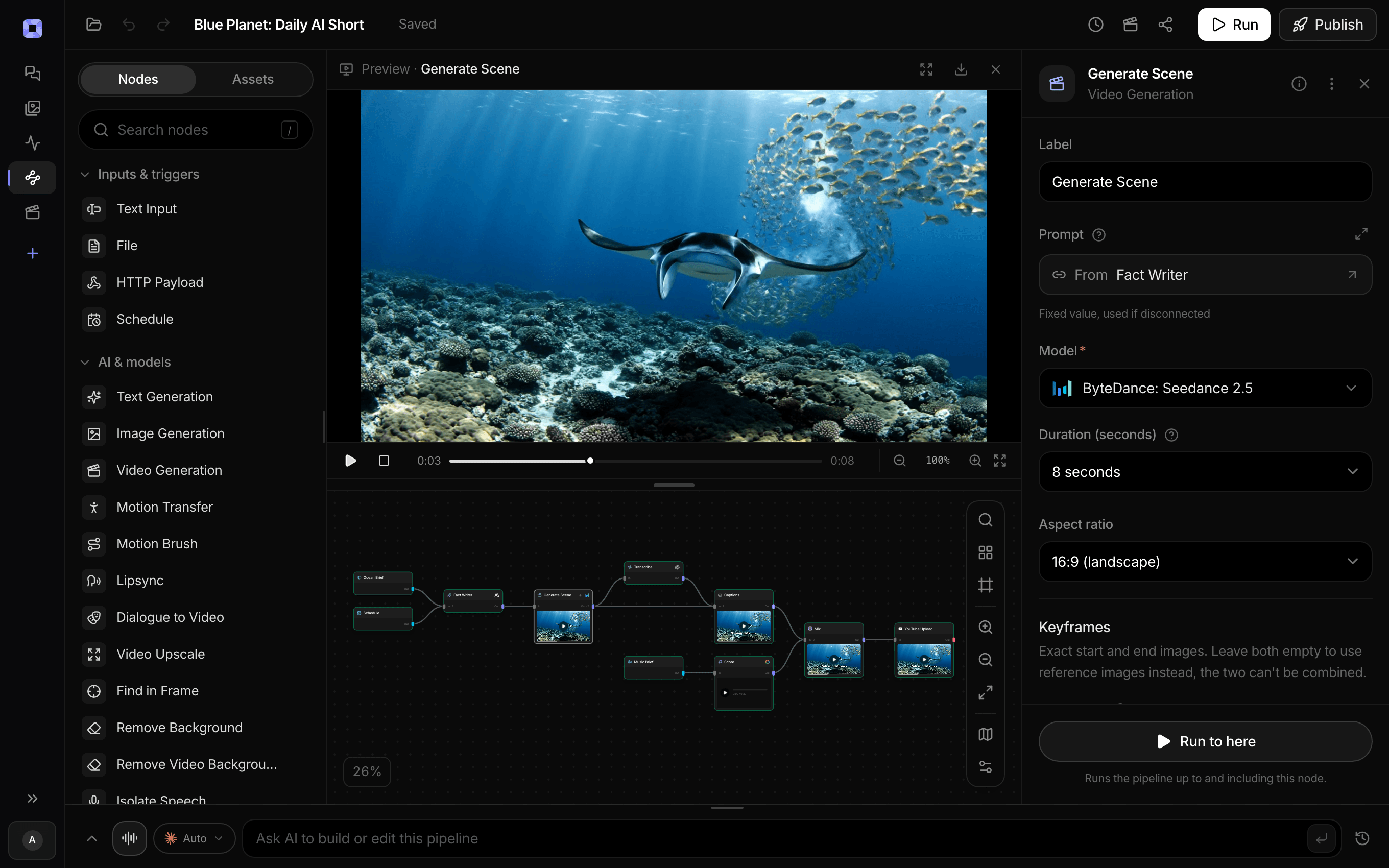
Ask for the pipeline in the composer, or send it from Claude over MCP.
What people build with it
Overgrown yard to lawn and patio
Waist-high weeds and a broken fence to a clean lawn with a paved seating area. Clearing and laying the patio give the middle stages plenty to show.
Landscaping content for Shorts
A yard a day in a different style: the same kind of shot, a new garden each time, for a landscaping or home channel.
Garden design ideas
Show a direction before any work starts. It is an illustration from a description, not a plan of your actual yard.
Front yards and curb appeal
A bare, patchy front yard brought back with a new path, edging, and planting in front of the house.
Decks, pools, and outdoor rooms
A neglected corner of the yard turned into a deck or an outdoor seating room, built up stage by stage.
Land cleared and graded
A scrubby lot cleared, levelled, and seeded, from one fixed camera at the edge of the site.

Generate it, cut it, publish it, in one place.
Prepaid credits, no subscription.
Backyard transformation video AI, answered
How do I make a backyard transformation video with AI?
Describe the yard as it is and the finished garden you want. On Treza, the Restoration Timelapse template draws the finished garden first, edits that picture back to the overgrown yard in five stages, and animates the work between them on Veo 3.1 into a vertical timelapse from one fixed camera.
Can it use a photo of my actual yard?
No. The template draws every stage from your description, so the result is an illustration of a transformation. Describe the layout, such as where the fence, the house, and the trees are, to get close to your yard.
Is this the same as the garden build page?
No. The garden build page starts from an empty plot and builds a new garden. This page starts from a yard that is already there, overgrown or worn, and brings it back.
Can I choose the garden style?
Yes. Describe the finish in plain words, such as a cottage garden with gravel paths, or a modern yard with a concrete patio and grasses. The planner writes it into the finished still.
How long is the transformation video?
The standard version is five 6-second clips joined with short crossfades, so a little under half a minute. It is vertical and renders without sound.
How much does it cost to make a backyard transformation video with Treza?
Treza runs on prepaid credits with no subscription. Each generation is charged at the model's own rate from your balance, and a failed generation costs nothing. A typical video generation settles around $1.06, and credit packs start at $5 and never expire.
Can I call this as an API instead of using the canvas?
Yes. Every pipeline can be published as a versioned HTTP endpoint. Call the typed /invoke endpoint with JSON in and JSON out, or point any OpenAI SDK at the OpenAI-compatible endpoint. Swap a model on a node later and the API your product calls does not change.
Do I need to know how to edit video?
No. Start from a template, change the topic, and run it. If you do want frame-level control, the timeline editor is there with multi-track video and audio, per-clip trims, fades, and volume, but nothing about the automated path requires opening it.
Related tools
AI garden build video generator
Garden and landscaping timelapses, from bare ground to finished
AI room makeover video generator
Room makeover timelapses from a tired room to a finished one
AI restoration video generator
Restoration timelapses from abandoned to restored, from one fixed camera
AI timelapse video generator
Construction timelapses from an empty site to finished, from one camera
See every tool, compare the models, read what an AI video pipeline is, or earn 30% sharing these tools.
Your first video is one prompt away.
Generate your first video, image, or draft today. Prepaid credits, no subscription.