

AI podcast clip generator
Turn every new podcast episode into captioned Shorts
Paste your show's RSS feed and the pipeline pulls the newest episode, finds its most shareable 30 to 60 second moment, builds a captioned vertical clip with generated cover art, and publishes it. No uploads and no manual clipping.
Everything on this page was made on Treza.
Starts from the RSS feed, not a file
Point the pipeline at any podcast feed URL and it reads the newest episode's audio itself. Pin a specific episode when you want to reach back into the catalog. Nothing to download, re-encode, or upload.
Finds the quotable moment
Whisper transcribes the whole episode with timestamps, then a language model reads the transcript and picks the strongest 30 to 60 second passage, landing on sentence boundaries with a hook title and a caption to match.
Cover art generated per clip
Audio needs a picture. A prompt written from the episode drives an image model that renders vertical cover art, so each clip gets its own frame instead of the same static logo card.
Captions cut to the clip
The extracted moment is transcribed again on its own timeline, so word-grouped captions land exactly on the audio. Three styles, five positions, and word-by-word grouping tuned for muted feeds.
Long episodes, cut in place
A two-hour master is transcribed in chunks and the clip is cut straight out of the source, so only the 60 seconds you keep is rendered. Episode length never becomes the reason a clip fails.
Posts to Shorts and TikTok
The YouTube Upload node posts the clip as an unlisted Short through the official API on your OAuth-connected channel, so nothing goes public until you have seen it. Add a TikTok Upload node to post it to TikTok too; TikTok has you choose who can view each post.
An episode, cut down
The transcript picks the moment, the crop follows whoever is talking, and the captions are the words they said. Shown on our own footage, because the clips we cut from other people's shows are theirs.

A recorded stream, clipped
Cut to vertical from the full-length source.
Whisper Large v3

Captioned for the feed
Burned in, sized for muted autoplay.
Captioned AI Short

Several moments, one post
Sequenced into a single vertical master.
Top 3 Countdown
From idea to finished video
- Step 01
Paste the feed
Drop your podcast's RSS URL on the feed node. The pipeline resolves the newest episode's audio, or the one you pin.
- Step 02
Let it find the highlight
Whisper produces a timestamped transcript and the highlight picker chooses the best 30 to 60 seconds, with a title and caption for the post.
- Step 03
Cut, dress, caption
Extract Clip cuts that range, generated cover art fills the vertical frame, and the captions node burns in the words so the clip works on mute.
- Step 04
Preview, then publish
Check the clip on the canvas, then set the YouTube node to public, or add a TikTok Upload node to post it there. Add a schedule trigger that matches your release day and the show clips itself.
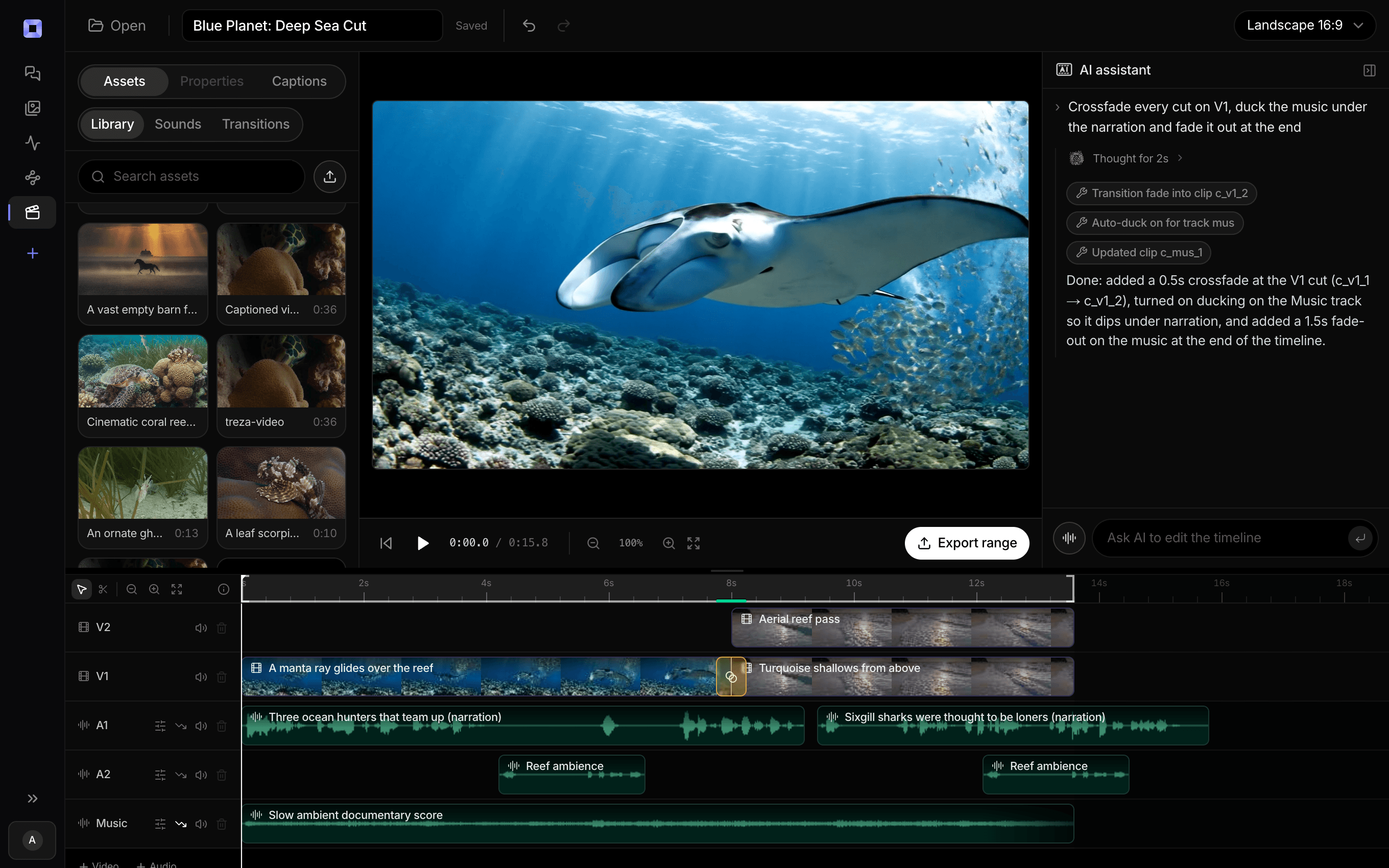
The same video, open in the built-in timeline editor.
What people build with it
Audio-only shows that want a video presence
Most podcasts never make it to YouTube or TikTok because there is nothing to look at. Generated cover art plus captions turns an audio moment into a watchable Short.
Weekly episode, weekly clip, no editor
Run the pipeline on the morning your episode drops. The clip is cut, captioned, and sitting unlisted on your channel before you have finished your coffee.
Guest promotion
Clip the guest's sharpest line and hand them a vertical they will actually repost. The hook title is written from what they said, not from the episode name.
Back-catalog revival
Pin older episodes and run the pipeline per episode. A three-year archive becomes a feed of clips without anyone re-listening to it.
Video podcasts too
If you record video, use the clip generator instead: it cuts from your master and crops the speaker into a vertical frame rather than generating art.
Clips as an API
Publish the pipeline as an endpoint and call it from your CMS or hosting platform whenever a new episode is published.

AI podcast clip generator, answered
How do I turn a podcast into clips with Treza?
Open the Podcast Clip Factory template, paste your show's RSS feed URL, and run it. The pipeline pulls the newest episode, transcribes it, picks the most shareable 30 to 60 second moment, generates vertical cover art, burns in captions, and uploads the clip to your YouTube channel as an unlisted Short. Add a TikTok Upload node to post it to TikTok as well.
Does it need the podcast as a video?
No. It is built for audio-only shows: the picture is generated cover art driven by a prompt written from the episode. If you do have a video recording, the AI clip generator cuts the moment from your footage instead and crops the speaker into a vertical frame.
How does it choose which moment to clip?
The full transcript, with timestamps, goes to a language model that is asked for the single most shareable passage of 30 to 60 seconds that stands on its own without context. It returns the start and end times plus a hook title, and the Extract Clip node cuts exactly that range.
Can it clip a specific older episode?
Yes. By default the pipeline takes the newest item in the feed. Set the episode pick to a title or number and it reaches into the catalog for that one instead, which is how you work through a back-catalog.
Can it run automatically when a new episode comes out?
Add a schedule trigger set to your release cadence, for example every Tuesday morning, and the pipeline runs itself and clips whatever the newest episode is. The YouTube node uploads each clip unlisted until you set it to public.
Does it work with Spotify, Apple, or YouTube links?
It works from your podcast's RSS feed, which every hosting platform provides, and from your own uploaded audio or direct media URLs. It does not download from Spotify, Apple Podcasts, or YouTube pages.
How much does it cost to make ai podcast clip generator with Treza?
Treza runs on prepaid credits with no subscription. Each generation is charged at the model's own rate from your balance, and a failed generation costs nothing. A typical video generation settles around $1.06, and credit packs start at $5 and never expire.
Can I call this as an API instead of using the canvas?
Yes. Every pipeline can be published as a versioned HTTP endpoint. Call the typed /invoke endpoint with JSON in and JSON out, or point any OpenAI SDK at the OpenAI-compatible endpoint. Swap a model on a node later and the API your product calls does not change.
Do I need to know how to edit video?
No. Start from a template, change the topic, and run it. If you do want frame-level control, the timeline editor is there with multi-track video and audio, per-clip trims, fades, and volume, but nothing about the automated path requires opening it.
Related tools
AI clip generator
Clipping webinars, interviews, and talks into vertical shorts
AI video transcriber
Transcripts, SRT files, and captions from your recordings
AI shorts generator
Vertical short-form video for TikTok, Reels, and Shorts
See every tool, compare the models, read what an AI video pipeline is, or earn 30% sharing these tools.
Your first video is one prompt away.
Generate your first video, image, or draft today. Prepaid credits, no subscription.