

x402 video generation API
Video generation your agent can pay for with a wallet
An x402 video generation API sells finished video over HTTP: the request carries a USDC payment instead of an API key. POST a prompt to Treza's endpoint, let the wallet answer the 402 challenge, and get the video URL back in the same response, or a status URL to collect it from. No account, no key, no signup.
Everything on this page was made on Treza.
The payment is the only credential
There is no signup form, API key, or OAuth flow anywhere in the path. An agent that holds a funded wallet can discover the endpoint, pay the 402 challenge, and collect a finished video with no human in the loop.
Priced per second, quoted per request
The 402 challenge quotes the exact price of the clip you described: $0.42 for 5 seconds, $0.84 for 10, $1.26 for 15 on the default model, and its own ladder for Veo 3.1, Kling 3.0, Wan 2.7, Seedance 2.5 or any other model you name. The rate is our measured provider cost times the same markup human customers pay, so it moves when the model's price moves.
Real production renders
Every purchase runs a frozen, versioned pipeline on the same engine behind the rest of the platform, in 16:9 landscape or 9:16 vertical, from a prompt or from an image you send as the first frame. This is the path our own published channels render on, not a demo model.
Built for agent discovery
The endpoint is listed in the x402 Bazaar with a machine-readable input schema, output example, and per-model prices, so an agent's planner can evaluate the offer and commit a payment without a docs page in the loop.
Quick renders come back in the same call
A paid POST waits about as long as the chosen model usually takes to render, and returns the video URL in the same response when it is ready. Every response also carries a status URL containing a signed claim ticket, the proof of purchase, and polling it for a longer render is free. No webhooks, which suits agents that have a wallet but nowhere to receive a callback.
Overpayment becomes balance, not loss
A settled payment credits an account keyed to the paying wallet, and the render spends from it at the normal rate. Whatever a render does not use stays on that wallet's balance for its next call.
A failed render is not a lost payment
If the model refuses a prompt or a render does not finish, nothing is charged for it. The response says what happened in the provider's own words and carries a retry link that renders again, with the same or a reworded prompt, without paying twice.
What an agent gets for one payment
No account, no subscription, no dashboard. A 402 quote, a payment, and a finished file back.

A five second clip
Priced per second, quoted before you pay.
Veo 3.1 Fast

A product shot
Pick the model in the request.
MiniMax Hailuo 3 Max

A finished master
An mp4 URL, not a job to poll forever.
Veo 3.1
From idea to finished video
- Step 01
POST a prompt
Send JSON with a prompt, a clip length (5, 10, or 15 seconds on the default model), an aspect ratio, and optionally a model or an image to start from. Unpaid, the response is a 402 challenge quoting the exact USDC price for that clip.
- Step 02
Let the wallet pay
An x402 client signs the payment authorization and retries the request with it attached. The payment verifies and settles on Base or Solana, whichever the wallet pays from, before the render starts.
- Step 03
Hold the claim ticket
The paid response carries a status URL with a signed ticket from its first byte. That ticket is the proof of purchase, so store it: it is the only credential that can claim the video.
- Step 04
Collect the video
When the render is ready in time, the response ends with the video URL. Otherwise it ends with the status URL: GET it until the run finishes, then download the file. Polling costs nothing, because the render behind it is already paid for.
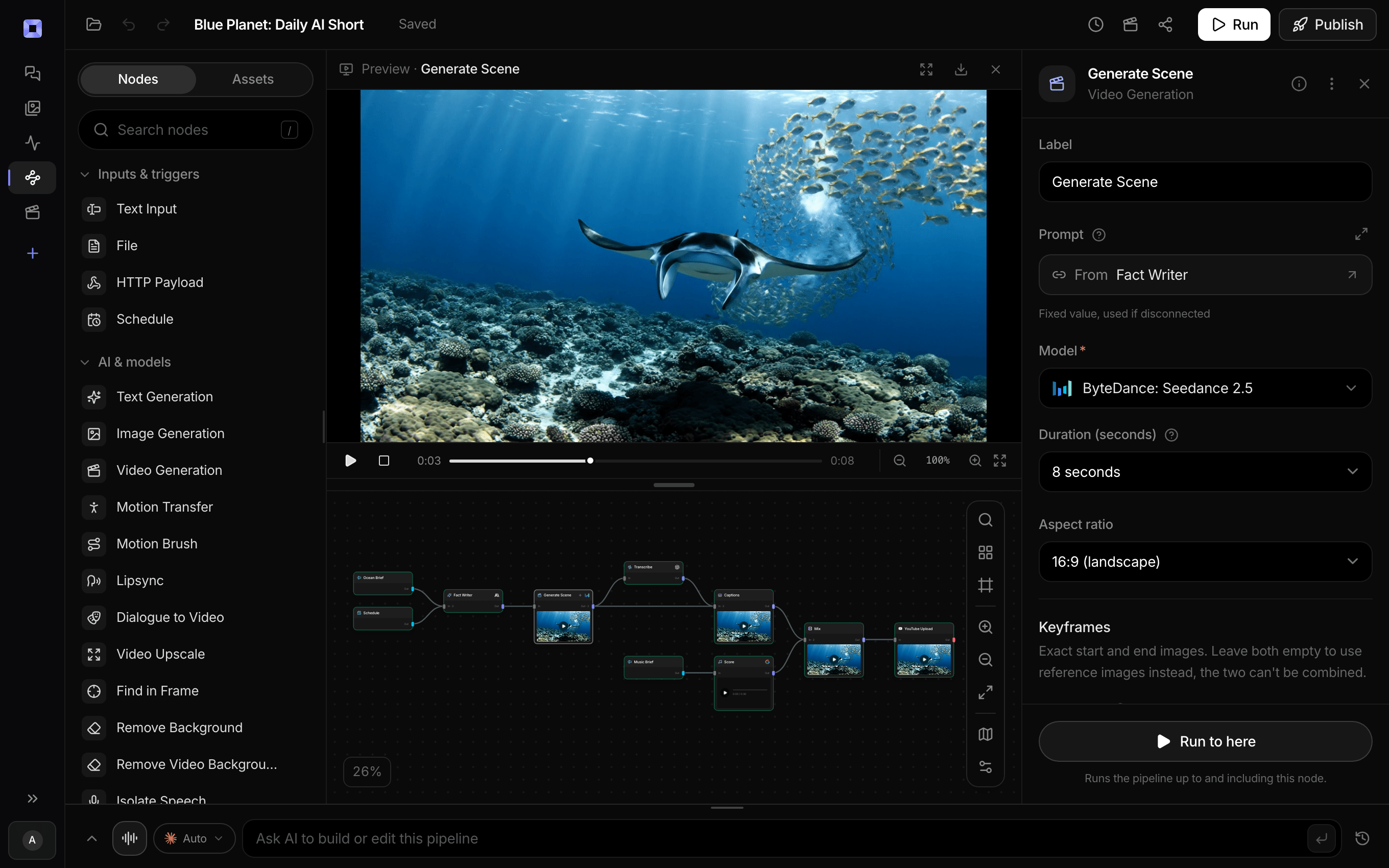
Ask for the pipeline in the composer, or send it from Claude over MCP.
What people build with it
Agents that produce content end to end
An autonomous agent researching a topic can buy the video for its own post mid-task, paying per clip instead of carrying a platform subscription it uses twice a week.
Apps that refuse to manage API keys
A product that needs occasional video generation can hold a wallet instead of a vault of provider keys, and its unit economics are visible per request.
MCP and tool-use workflows
A Claude or GPT agent with a wallet tool can quote the price to its user, pay for exactly one render, and hand back the file, all inside one conversation.
Crypto-native builders
If your stack already settles in USDC on Base or Solana, video generation becomes one more x402 service call, with the transaction hash as the receipt.
Pay-as-you-go prototyping
Trying a video idea costs one clip, not a signup, a card form, and a minimum top-up. The first render is the whole commitment.
Marketplaces and resellers
A service that composes other x402 services can add video generation to its catalog by forwarding a request, without holding an account with us.

Your agent pays for one video and gets one video.
HTTP 402, settled onchain, with no human in the loop.
x402 video generation API, answered
What is x402?
x402 is a payment protocol built on the HTTP 402 Payment Required status code. A paid endpoint answers an unpaid request with a 402 carrying structured payment requirements: the price, the token (USDC), the network, and the address to pay. The client signs a payment with its wallet and retries the request with the payment attached; the server verifies and settles it through a facilitator, then serves the resource. It replaces accounts, API keys, and card forms with a per-request payment, which is what autonomous agents need, since an agent can hold a wallet but cannot complete a signup flow.
Do I need a Treza account or API key to use this?
No. The payment is the entire relationship. A settled payment creates an account keyed to the paying wallet behind the scenes, which is what holds any unspent balance, but there is nothing to sign up for and no key to store. The signed ticket returned by the paid request is the only credential involved, and it only claims that one video.
What exactly does a video cost?
Price scales with clip length and model: $0.42 for 5 seconds, $0.84 for 10 seconds, and $1.26 for 15 seconds on the default model, in 16:9 or 9:16. A GET on the endpoint with no parameters lists every model on sale with its own ladder, including Veo 3.1, Kling 3.0, Wan 2.7 and Seedance 2.5, and a model field in the request picks one. The 402 challenge always quotes the exact price for the request you sent before any money moves, and the rate derives from measured provider cost, so it changes when the underlying model's price does.
Which network and token does it settle on?
USDC on Base mainnet or Solana mainnet, settled through Coinbase's x402 facilitator. The 402 challenge lists both at the same price, and your client pays with whichever wallet it holds, with no gas money needed on either. The response to a paid request includes the on-chain transaction hash or signature, so every purchase has a public receipt.
What happens if the request is invalid, or I pay too much?
Validation runs after the payment verifies but before it settles, so a request for a size we do not sell, or an image we cannot use, is refused with your money untouched. When a payment does settle, it credits a balance keyed to your wallet and the render spends from it at the normal rate, so an overpayment stays on your balance for the next call instead of disappearing.
Can I use this without being an AI agent?
Yes, any x402-capable client with a funded wallet works, including a developer at a terminal. If you would rather have a canvas, templates, scheduling, and publishing around your video generation, that is the Treza platform itself, and it takes a normal signup and prepaid credits instead of a wallet.
How much does it cost to make x402 video generation api with Treza?
Treza runs on prepaid credits with no subscription. Each generation is charged at the model's own rate from your balance, and a failed generation costs nothing. A typical video generation settles around $1.06, and credit packs start at $5 and never expire.
Can I call this as an API instead of using the canvas?
Yes. Every pipeline can be published as a versioned HTTP endpoint. Call the typed /invoke endpoint with JSON in and JSON out, or point any OpenAI SDK at the OpenAI-compatible endpoint. Swap a model on a node later and the API your product calls does not change.
Do I need to know how to edit video?
No. Start from a template, change the topic, and run it. If you do want frame-level control, the timeline editor is there with multi-track video and audio, per-clip trims, fades, and volume, but nothing about the automated path requires opening it.
Related tools
AI video generator
The full video pipeline, from prompt to published
Generate videos from Claude
Running your video pipelines from Claude and other MCP clients
AI video automation
Scheduled channels, event-triggered videos, and API-driven batches
See every tool, compare the models, read what an AI video pipeline is, or earn 30% sharing these tools.
Your first video is one prompt away.
Generate your first video, image, or draft today. Prepaid credits, no subscription.