

AI Drawing Animator. Act out a move, and your drawing does it.
Scan a character you drew, film yourself doing the move, and Treza's Motion Transfer node makes the drawing perform it. The movement comes from your take; the character comes from your page.
Everything on this page was made on Treza.
The drawing, kept as drawn
With the picture leading on Kling 3.0 Motion Control, the character stays exactly as pictured for clips up to 10 seconds, so it is your linework and your colours that move.
You are the animator
Film yourself doing the move. The node reads body movement and facial expression from the clip and drives the drawing with them, so a wave, a bow, or a little walk comes out on your timing.
Any drawing, any medium
The node takes any picture as the character: pencil, ink, marker, paint, or a digital drawing. Nothing in it checks for a photo or a 3D render, so a character you drew by hand goes straight in.
The page is the backdrop
Kling keeps everything around the character in the picture, in every frame: the paper, a smudge, the table edge if it is in the shot. Crop to the page, or draw the character in the place you want it to stand.
Do the voice while you act
Kling carries the clip's sound into the result, on by default, so whatever you say while you perform plays under the drawing in time. Switch it off for a silent clip.
Up to 30 seconds
Up to 10 seconds with the drawing leading, which keeps it as drawn, and up to 30 with the video leading, which follows your movement more closely. An Extract Clip node trims longer footage.
No clip? Draw the motion instead
Motion Brush moves a still without a performance: paint up to six regions on the drawing, drag a path for each, and they move along your paths in a 5 or 10 second shot.
Made on this platform
Real output, credited under every frame.

Architectural
A dolly through a sunlit room.
Seedance 2.5

Product
A macro turn under a sweeping light.
Kling 3.0 Pro

A channel cut
Written, voiced, captioned, and published on a schedule.
Seedance 2.5
From idea to finished video
- Step 01
Scan the drawing
The whole character, head to feet, facing out of the page. Scan it, or photograph it flat in even light, then crop to the paper so nothing else is in the picture.
- Step 02
Film the move
Record yourself doing it: one continuous shot, whole body in frame, a steady camera, 5 to 10 seconds. Slow, front-on moves come back cleanest.
- Step 03
Put the two together
Attach the drawing and the clip in chat and ask for the drawing to do the move, or open the Motion Transfer template and put the drawing on the node on the canvas, in place of the generated character.
- Step 04
Share it
Kling takes about 5 minutes for 10 seconds. Download the video, caption it, cut a few takes into a Sequence, or post it with the YouTube or TikTok upload node.
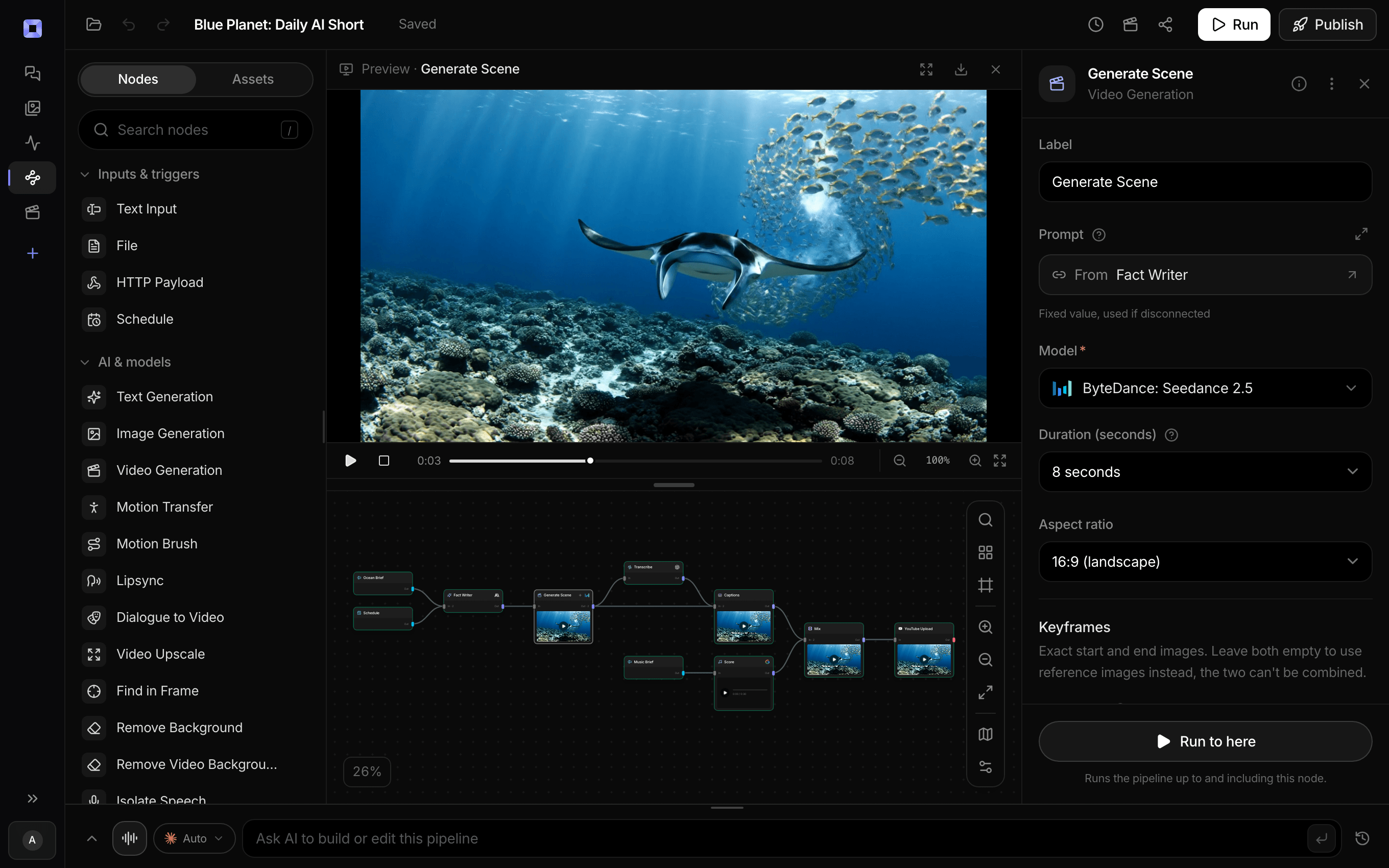
Ask for the pipeline in the composer, or send it from Claude over MCP.
What people build with it
A drawing from the fridge door
Your child's monster, cat, or superhero waves back. You act out the move and do the voice, and the drawing performs it.
Comic and webcomic characters
Act out a beat for your own comic's hero and post the drawing performing it next to the new page.
Test a character design
See how a character you designed moves before you animate it frame by frame or hand it to an animator.
Picture book characters
Illustrators put their own characters through a wave, a bow, or a walk for a launch post or a reading.
Sketchbook to Short
A page from the sketchbook and a ten second performance become a clip to post next to the drawing itself.

AI drawing animator, answered
How do I animate a drawing with AI?
Scan or photograph your drawing, film yourself doing the move, and give both to Treza's Motion Transfer node. Kling 3.0 Motion Control reads your body movement and expression from the clip and returns a video of the drawn character doing the same thing, with the drawing kept as pictured.
Does it work on hand-drawn characters?
Yes. The character can be any picture: nothing in the node checks for a photo or a 3D render, so pencil, ink, paint, and digital drawings go in the same way. Stylised characters tend to hold together better than a photoreal face, which is the hardest thing for the model to track.
What kind of drawing works best?
A whole figure, head to feet, standing and facing out of the page, with clear space around it. Whatever surrounds the figure in the picture stays in every frame, so crop to the paper, keep shadows off it, and leave the desk out. A "transparent" PNG with a checkerboard painted in shows the checkerboard too.
Do I have to act it out?
For this tool, yes: the movement comes from a clip, yours or one you have the rights to use. Without one, Motion Brush moves regions of the drawing along paths you drag, and Image to Video starts a shot from the drawing and moves it the way a written prompt says. Image to Video
Will my drawing change shape?
Not with slow moves. Fast spins, jumps, and arms crossing the body are frames the model has to guess, and it guesses toward your body rather than the drawing's, so a character can come back with human hands or legs. A slow, front-on take keeps the drawing intact.
Can I animate any drawing?
Animate characters you drew or own, with a clip you recorded or have the rights to use. This is not a face swap or a deepfake tool: do not use it on a drawing or photo of a real person who has not agreed, and do not use it to replace actors in films or shows.
How much does it cost to make an animated drawing with Treza?
Treza runs on prepaid credits with no subscription. Each generation is charged at the model's own rate from your balance, and a failed generation costs nothing. A typical video generation settles around $1.06, and credit packs start at $5 and never expire.
Can I call this as an API instead of using the canvas?
Yes. Every pipeline can be published as a versioned HTTP endpoint. Call the typed /invoke endpoint with JSON in and JSON out, or point any OpenAI SDK at the OpenAI-compatible endpoint. Swap a model on a node later and the API your product calls does not change.
Do I need to know how to edit video?
No. Start from a template, change the topic, and run it. If you do want frame-level control, the timeline editor is there with multi-track video and audio, per-clip trims, fades, and volume, but nothing about the automated path requires opening it.
Related tools
AI motion transfer
A character that performs your filmed take, or replaces the performer in it
AI image to video generator
Motion from a photo, poster, or generated key frame
AI anime character video
An original anime character performing a take you act out
AI mascot animation generator
A brand mascot performing a move someone on the team filmed
See every tool, compare the models, read what an AI video pipeline is, or earn 30% sharing these tools.
Your first video is one prompt away.
Generate your first video, image, or draft today. Prepaid credits, no subscription.