


AI History Video Generator. A narrated history short from one topic.
Name an era, an event, or a story history forgot, and Treza writes it as a 45 to 55 second episode with five generated scenes, a documentary narrator, a music bed, and burned-in captions. Connect a YouTube channel and a new history Short can post every day.
Everything on this page was made on Treza.
An episode, not a list of dates
A writer model turns your niche into one episode: a hook in the first sentence, one surprising and specific detail it builds to, and a closing line that sets up the next. It also writes the YouTube title, the description, and a prompt for each scene.
Five scenes in a period look
Each scene is a vertical still written in a visual style that suits the niche, then a slow push-in and a fade carry it into the next, so it reads as camera rather than a slideshow. Name a look in the niche, like oil painting or engraving, and the scene prompts are written to suit it.
No invented portraits of real people
The writer is told never to put a real person in a scene, so an episode about an emperor shows his city, his ships, and the crowd at his gates instead of a made-up face. It is told to keep text, letters, and logos out of every scene too.
A documentary narrator over a score
A deep documentary voice from ElevenLabs reads the script while a music model scores an instrumental bed from a one-line brief the writer wrote for that episode. The bed is ducked 12 dB under the voice, and the cut ends when the narrator does.
Names captioned the way they are spelled
The narration is transcribed word by word and checked against the written script, so Hatshepsut and Tenochtitlan are captioned as written. Captions burn in three words at a time with the spoken word in yellow.
A new subject every day
A schedule trigger runs it daily, and the writer looks back over its last 30 episodes, so each run it is told what the channel already covered and picks something new. The YouTube node posts each one as a Short.
Episodes this template made, in a space niche
Runs of the Faceless Channel Short on one of our own channels, captions as they were burned in. We have not published a history channel; a history niche goes through the same writer, scenes, narrator, and captions.

One run, as it came out
Scene, narration, and captions from a single run.
Faceless Channel Short

The next day's episode
Another day of the same channel format.
Faceless Channel Short

The spoken word in color
Captions land as the narrator says them.
Faceless Channel Short
From idea to finished video
- Step 01
Name the history
Type the era, event, or kind of story into chat, or keep the request the button wrote, and it becomes the niche every episode is written from. Run the template untouched and its example niche, mysteries of the deep ocean, runs instead.
- Step 02
Run the first episode
The Faceless Channel Short is about $0.78 a run, priced before it starts. The script, the five scenes, the narration, the music, and the captions come back as one vertical Short in the chat.
- Step 03
Check the facts before anyone sees it
Read the script first. Names, dates, and numbers come from a language model and can be wrong, so check them against a source you trust. Then rerun a weak scene, change the voice, or tighten the niche.
- Step 04
Connect YouTube and schedule it
Connect a channel and ask for a daily schedule. Keep uploads Unlisted or Private while you are still checking episodes, and set a daily spend cap so the schedule pauses itself at your budget.
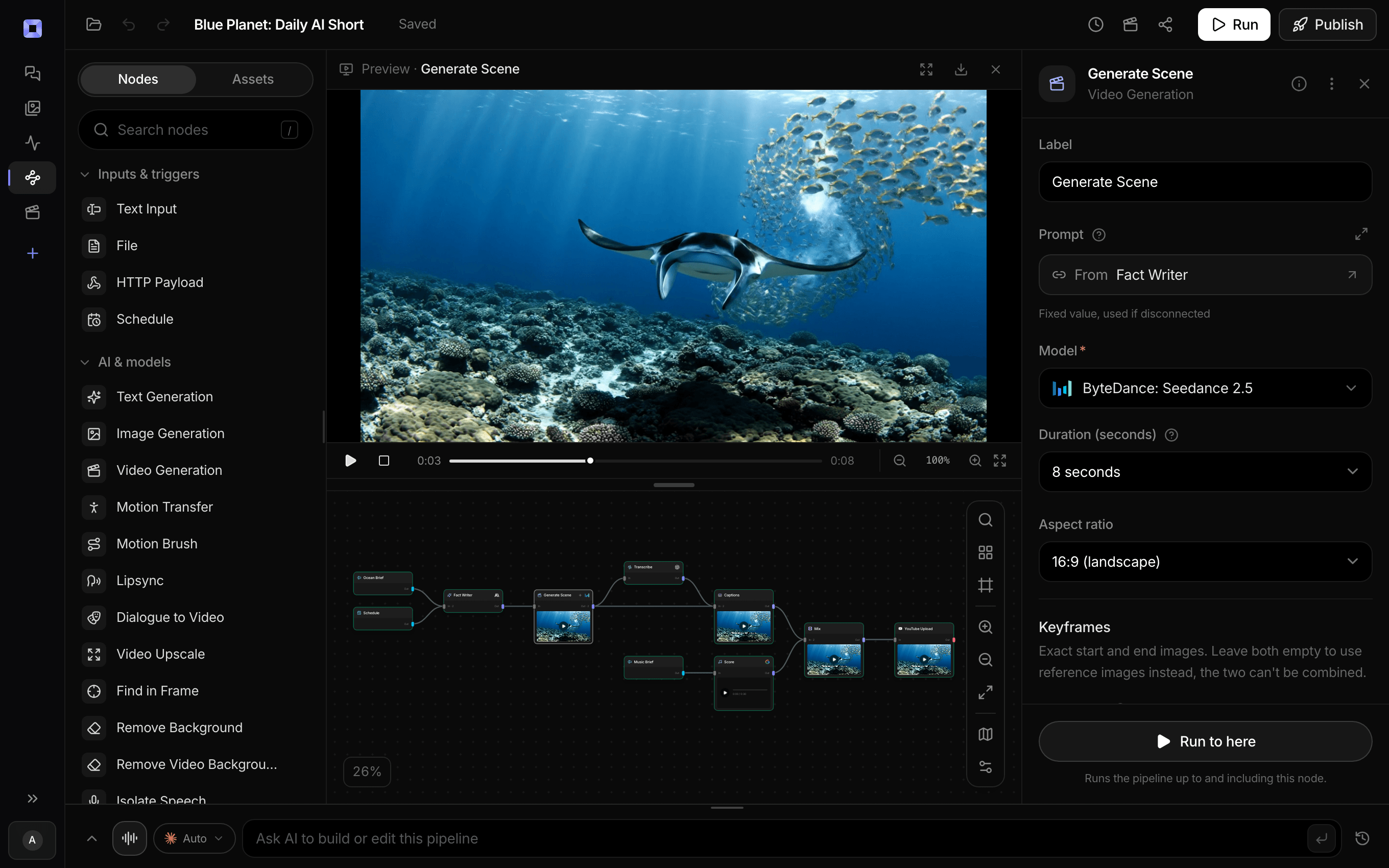
Ask for the pipeline in the composer, or send it from Claude over MCP.
What people build with it
A daily history Shorts channel
One event, person, or place per episode, posted every day, from the first cities to the twentieth century.
Forgotten and strange history
The writer is built to land on one surprising, specific detail, which is the shape of a lost expedition, an odd law, or an invention nobody remembers.
Ancient civilizations
Rome, Egypt, Mesopotamia, the Maya. Nobody has footage of them, so generated scenes are the only pictures a video about them could have.
Battles and turning points
A siege, a crossing, a decision that moved a border, told through the walls, ships, and crowds around it rather than a portrait of the general.
A history primer before a lesson
A short narrated introduction to a period for a class or a study group, captioned for a quiet room. Check the script against your own notes first.
History Shorts in another language
Write the niche in the language your audience speaks and the writer scripts the episode in it, so the narration and the captions follow.
One era. Five scenes. Every day.
A narrated history Short from your niche. Check the facts, then let it post.
AI history video generator, answered
What is an AI history video generator?
An AI history video generator turns a historical topic into a narrated video. On Treza, the Faceless Channel Short template writes a 45 to 55 second episode from your niche, generates five vertical scenes, narrates them over a music bed, burns in captions, and can post a new history Short to YouTube every day.
Is the history accurate?
Not automatically. The writer is told to build each episode on one true, specific detail, but it is a language model and it can get a name, a date, or a number wrong. Check every script before it posts, and keep the YouTube upload on Unlisted or Private until you trust the niche.
Can it show real historical figures?
Not as portraits. The writer is told never to depict a real person in a scene, so an episode about a ruler or an inventor shows the places, objects, and crowds of the story. The narration still names them and tells their part.
Are the scenes moving footage?
They are generated stills, each with a slow push-in and a fade into the next, which keeps a run at about $0.78. For scenes animated by a video model, the Fact of the Day template animates its four scenes, at a higher price per run.
How long is each history video?
About 45 to 55 seconds: the writer scripts 110 to 130 spoken words and the cut ends with the narration. For a longer piece, join several episodes in the timeline editor, which exports up to 40 clips or 15 minutes.
How is this different from a historical POV video?
A POV video puts the viewer inside one moment, in the second person, every shot seen through their eyes. This template tells the story in the third person, with a narrator over five scenes. Our guide covers the POV format step by step. How to make historical POV videos with AI
How much does it cost to make a history video with Treza?
Treza runs on prepaid credits with no subscription. Each generation is charged at the model's own rate from your balance, and a failed generation costs nothing. A typical video generation settles around $1.06, and credit packs start at $5 and never expire.
Can I call this as an API instead of using the canvas?
Yes. Every pipeline can be published as a versioned HTTP endpoint. Call the typed /invoke endpoint with JSON in and JSON out, or point any OpenAI SDK at the OpenAI-compatible endpoint. Swap a model on a node later and the API your product calls does not change.
Do I need to know how to edit video?
No. Start from a template, change the topic, and run it. If you do want frame-level control, the timeline editor is there with multi-track video and audio, per-clip trims, fades, and volume, but nothing about the automated path requires opening it.
Related tools
Faceless video generator
Faceless YouTube and TikTok channels that publish on a schedule
AI mythology video generator
Narrated myth retellings, one legend per Short
AI documentary video generator
Narrated mini-documentaries and documentary series
Fact video generator
Daily one-fact documentary Shorts with narration and callout labels
See every tool, compare the models, read what an AI video pipeline is, or earn 30% sharing these tools.
Your first video is one prompt away.
Generate your first video, image, or draft today. Prepaid credits, no subscription.