Mischief 1 vs Seedance 2.0: Same Still, Same Prompt, One Kept the Shirt
We gave TBC's Mischief 1 and ByteDance's Seedance 2.0 the same photo of a folded shirt and the same five second prompt. One cost five cents, rendered in 20 seconds and kept the shirt in frame. The other cost about 76 cents, took over two minutes, came back with sound and truer cloth, and lost the shirt. What each model accepts, what each charges, and what the two clips show.

Mischief 1 is the cheapest video model on Treza: it animates a still you give it for half a cent a second at 480p and a cent at 720p, in 16:9, with no sound. Seedance 2.0 is the full tier of ByteDance's Seedance 2.0 family: text or image in, first and last frames, reference images, seven aspect ratios up to 4K, sound generated with the picture, at roughly fifteen times the price per second. On 2 November 2026 we ran both from the same still with the same prompt at the same settings. Mischief 1 kept the subject in frame and Seedance 2.0 did not, and that is not the whole story.
Every parameter and listed price below is read off Treza's live video model catalog as of November 2026. One render is one render; nothing here claims either model always behaves this way.
The short version
- Mischief 1 is the draft model. Image to video only, 3 or 5 seconds, 16:9 only, 480p or 720p, silent, 16 frames a second in our test. A 5 second 720p clip is five cents of provider cost and ours rendered in 20 seconds.
- Seedance 2.0 is the production model. Text or image in, first and last frame keyframes, reference images that carry a product or character across shots, 4 to 15 seconds, seven aspect ratios, 480p to 4K, native audio, 24 frames a second. The same clip is about 76 cents at the listed token rate and ours took 131 seconds.
If you have a still and want to see whether it moves well, Mischief 1. If the clip is the deliverable, needs sound, needs a vertical or square frame, or has to land on a second image, Seedance 2.0.
Parameter comparison
| Mischief 1 | Seedance 2.0 | |
|---|---|---|
| Input | A first frame plus a prompt. A prompt alone is refused | Text, first and last frames, reference images |
| Clip length | 3 or 5 seconds | 4 to 15 seconds, exact |
| Aspect ratios | 16:9 only | 7, from 1:1 to 21:9 and 9:21 |
| Resolutions | 480p, 720p | 480p, 720p, 1080p, 4K |
| Audio | None | Generated with the clip |
| Frame rate in our test | 16 fps | 24 fps |
| Listed cost, 5 seconds at 720p | $0.05 | About $0.76 |
| Render time in our test | 20 seconds | 131 seconds |
The Seedance figure is its listed price per video token applied to a 720p 16:9 frame, the same arithmetic as in the Seedance 2.0 Fast pricing post.
The test
One still: a photo of a folded navy linen shirt on an oak table, a shaft of afternoon sun across it. Both models got that image as the first frame, 5 seconds, 720p, and this prompt:
A hand reaches in, grabs the collar of the folded navy linen shirt and lifts it, shaking it out in one motion: the folds open, the sleeves swing down and the fabric ripples and settles as it hangs in the sunlight, dust motes drifting through the beam. Handheld close-up, natural sound of fabric.
That is a lot to ask of five seconds, which was the point.
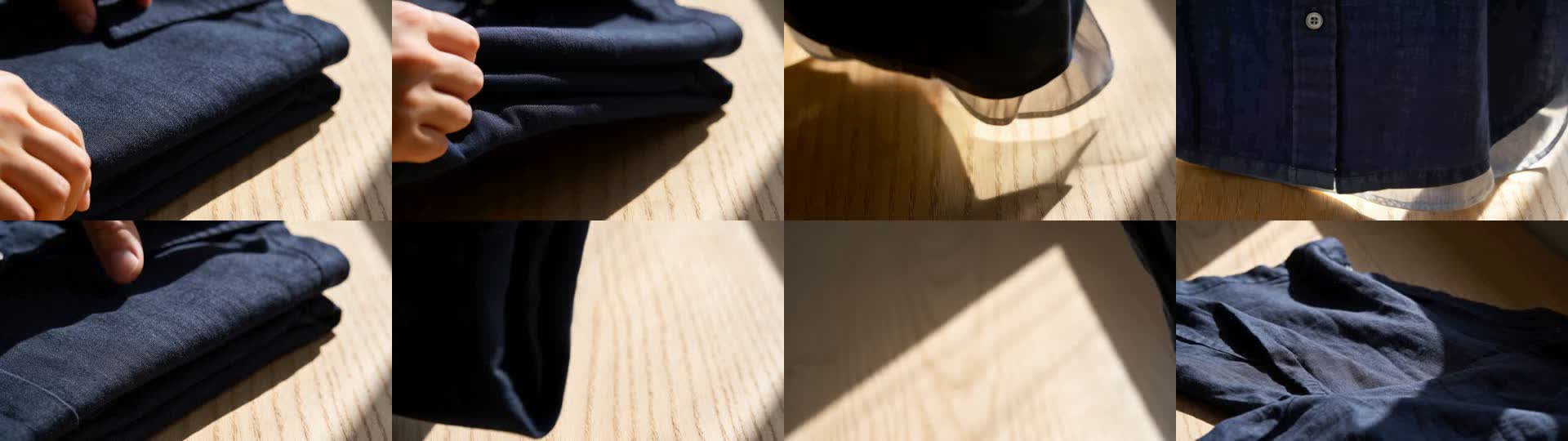
Top row, Mischief 1. Bottom row, Seedance 2.0. Frames taken at the same points in each clip.
What Mischief 1 did
The hand came in from the left, closed on the collar, and lifted. By the middle of the clip the shirt was hanging, hem down, and it stayed in frame to the end, a cuff button and the stitched hem in the sunlight. That is the shot the prompt asked for, in order.
Two things it got wrong. The lift drew a ghostly second layer of fabric under the hem, a translucent pale edge trailing the real one, visible in the third and fourth frames above. And at 16 frames a second the shake reads a little stepped next to the Seedance clip's 24.
There is no sound; the prompt asked for it and Mischief 1 is picture only. The file came back at 1280 by 720 in 20 seconds, at the listed five cents.
What Seedance 2.0 did
The first second is the better of the two clips. The hand grabs the folded shirt and the linen looks like linen: the weave, the folded edge catching the light, the small resistance in the cloth as it is pulled. Seedance 2.0 renders cloth better than Mischief 1 does, at 24 frames a second, with a sound track underneath.
Then it lost the subject. The lift carried the shirt up and out of the top of the frame, the table sat empty for a stretch, and the clip ended with the shirt dropped back on the wood in a heap. Not hanging, not settling in the light. A camera that stays on the table while the shirt rises out of it is one reading of "handheld close-up", but it is not the shot that was asked for. A prompt that has the camera follow the shirt, or a last frame pinned to a hanging shirt, would likely fix it. Those are extra instructions, and on this prompt Mischief 1 did not need them.
The file came back at 1280 by 720, 24 frames a second with an audio track, in 131 seconds, billed within a cent of the listed rate times five seconds.
What one render does not settle
The test used one first frame, the only input Mischief 1 can take, so nothing above exercises what Seedance 2.0 adds: a last frame so a clip lands on an exact image, reference images so a product or character stays recognizably itself across generations, vertical and square frames, 1080p and 4K. For a campaign where the same shirt has to appear in a landscape hero, a vertical story and a square post, those inputs are the job, and Mischief 1 cannot do any of it. One limit on the Seedance side: the endpoint rejects reference images containing a recognizable real person, and the Seedance 2.0 model page names the models to use instead.
Price and speed
Mischief 1 is listed at $0.005 a second at 480p and $0.01 at 720p. The most expensive clip it can make, 5 seconds at 720p, is five cents, and ours billed exactly that.
Seedance 2.0 is listed at $0.000007 per video token, and ByteDance counts tokens by frame area and frames. At a 720p 16:9 frame that is about 15 cents a second, so about 76 cents for 5 seconds; at 480p about 7 cents a second. Our render landed within a cent of the 720p figure.
The useful way to read fifteen to one is in drafts: fifteen Mischief 1 attempts, each a different still or a different line of motion, cost what one Seedance 2.0 attempt costs. Speed points the same way. Twenty seconds is fast enough to use interactively: wire a still into the image to video generator, ask for the move, and see it before you have written the next prompt. Just over two minutes is a render you submit and come back to, which is how a scheduled AI video pipeline runs anyway.
On Treza both are metered from prepaid credits, packs start at $5, credits do not expire, and a failed generation charges nothing.
The graph this test suggests
- The still: an uploaded photo or an Image Generation node. For a product, a clean photo of the real thing; the AI product video generator is set up for that.
- A Video Generation node on Mischief 1 at 480p for the draft pass, every candidate still and every candidate prompt, read in a minute.
- The same node switched to Seedance 2.0 for the keeper, resolution raised, audio on, a last frame or references if the shot has to land somewhere specific.
The first frame post covers wiring the still on the video side, and the AI video generator is where to try either model on your own image without building the graph. Mischief 1's rate card and what its endpoint refuses are in the Mischief 1 pricing post.
Bottom line
On one real render, the five cent model followed the prompt and the 76 cent model did not. That is worth knowing and it is not the decision. Seedance 2.0 rendered better cloth, at a smoother frame rate, with sound, and it accepts the inputs that make a clip part of a campaign rather than a one-off. Use Mischief 1 to find out whether a still moves well and which way to move it. Use Seedance 2.0 to make the clip you will publish, and build the graph so that is the same node with a different dropdown.
Frequently Asked Questions
Is Mischief 1 better than Seedance 2.0?
On the single render in this post, Mischief 1 followed the prompt more faithfully: it kept the shirt in frame and ended on it hanging, while Seedance 2.0 lifted it out of frame and dropped it. Seedance 2.0 rendered more convincing cloth, at 24 frames a second with sound, and accepts last frames, reference images, seven aspect ratios and resolutions up to 4K, none of which Mischief 1 offers. Which is better depends on whether the clip is a draft or the deliverable.
How much cheaper is Mischief 1 than Seedance 2.0?
About fifteen times on a 5 second 720p clip. Mischief 1 is listed at one cent a second at 720p, so five cents for the clip. Seedance 2.0 is listed per video token, which at a 720p 16:9 frame is about 15 cents a second, so about 76 cents. At 480p the gap is similar: half a cent a second against about 7 cents.
Can Mischief 1 make a vertical video?
No. Mischief 1 renders 16:9 only, at 3 or 5 seconds, from a first frame. For a 9:16 Short or a square post, Seedance 2.0 covers seven aspect ratios including 9:16, 1:1 and 21:9.
Does Seedance 2.0 generate audio?
Yes. Seedance 2.0 generates a sound track with the clip, and our test render came back with one. Mischief 1 returns picture only, so its sound comes from a Text to Speech or Audio Generation node afterward.
Do I have to rebuild my pipeline to switch between them?
No. Both models sit in the picker of the same Video Generation node. Switch the dropdown and the node offers only the settings that model supports, so aspect ratio and the last frame input appear for Seedance 2.0 and disappear for Mischief 1. The graph, the wiring and a published endpoint stay the same.